|
 |
|
Due to my health situation and inability to put 100% into the physical nature of our art, I am resigning my title of Co-director and will be an advisor to the Director, Terry Trahan.
I have full faith in Terry’s skill, not only as a martial tactician, but as a leader. I expect KSMA to be enriched by Terry’s flavors and look forward to seeing where the group grows.
Be well.
Jay
I
will fail at explaining this. Ultimately, I have to – there has never
really been a successful literary definition of "flow" for the martial
arts, and definitions change with perspective and ability. I stand with a
long line of distinguished attempts, though: Dan Inosanto, Herman
Suwanda, Bob Orlando, Cacoy Canete…in this respect, I'm in good company.
I'm going to attempt to make dozens of points about flow, but nothing
is going to nail it down completely because flow can really only be
described through feel, not through description. Anyone who knows how to
flow knows this. Anyone who doesn't will likely scoff at it.
I
used to think "Fluidity" meant "Speed". When I first began training,
the typical approach to fluidity was that the faster you could do
something, the more fluid you actually were. That the rate of speed you
could reach dictated the level of flow you had. And if I couldn't make
it faster, I made the technique higher - so a kick to the chest would
become a kick to the head. A foot sweep would become a thigh kick. I
have no idea why I did this, maybe I was going for flash if I couldn't
reach flow.
As laughably misguided as this was, there was no
way for me to discover how far off course I actually was (largely
through youth and natural dexterity). I was getting good results across
the board, because it was rehearsed to the nth degree. I could do my
forms extremely fast and precise, because I trained them into my bones.
However, I had no plan for adaptation, and no ability to recover if I
slipped, made an error or just plain forgot where I was (which happens
to everyone, at some time).
Speed comes with fluidity, but not
vice versa. You can't force the fit. Flow can fit into any martial art,
but it can't be contained or corralled by any. If you have flow, you
don't actually need a martial art. You can "become" any of them. Martial
arts don't normally "shrink down" to fit practitioners, or expand to
accommodate growth.
Flow does both of these, without force or stagnating, restrictive conventions.
There are several definitions of flow, with regards to the martial
arts. I'm going to address a few, but my chief point is completely
random flow; constant and unrehearsed.
The first problem is
acceptance: "Flow" seems to be the goal of almost every martial art in
the world, but obstacles and pitfalls are set in the path of the
practitioner that frequently lead them to believe otherwise. Ideas such
as lineage, dozens of forms, drills without end and a crispy white
uniform are attractive distractions from real knowledge. Further, the
logical thought process that fits with learning choreography as an
answer to every combative situation.
You'll see this in many
traditional martial arts, the need to define and propagate balance and
rooted stability over flow. The thought process is linear, first you
stand, then you walk, etc.
In my opinion, this is a kind of
ham-fisted attempt at re-inventing the stand-walk-run process. Fluidity
will save you where rooting cannot, in a combative scenario fluidity can
open lines of attack and evasion, where rooting and stillness tend to
encourage the practitioner into a "stand there and take it" mentality.
If you are training martial arts, chances are pretty good you have
already mastered balance in motion. The simple walking or running that
you did in school taught you everything you needed to know about
propulsion, balance, maintaining and the loss of balance, as well as
intermittent timing. This simplicity doesn't change with combat; the
only difference is in the variations that occur in application. In other
words, now you have to stay on your feet when the punches and kicks
come flying in!
That sounds odd, but when you look at the kinds
of people who manipulate both flow and balance in rhythm – dancers, for
instance – you see that it's naturally self-validating and completely
adaptive to sudden changes in tempo and terrain.
That's not to
overlook the one critical difference between dancing and combat: In
dance, no one is trying to kill you, there's usually no opposing force.
Just as the 2% difference in DNA between primates and humans makes all
the difference between having bananas or an omelet for breakfast, that
simple fact of violence certainly is the deciding factor between the
kind of balance in stillness you find in forms, and the fluidity of
balance in motion you find in actual combat.
Flow will save you
where strength, technique or speed cannot. Flow cannot be cheated, it
can't be faked. If you understand flow and the use of it, you will more
easily understand underlying principles that most classical martial arts
are built on, without having to train every step in the process of that
art. The ability to flow is a martial art unto itself, although it can -
and should - be applied in all martial arts.
Flow overrides
curriculum – you can teach curriculum out of flow, but not vice versa.
Everything considered in the martial realm as a "flow drill", whilst
absolutely useful as a primer to those who are just learning to relax
and move at high rates of speed, will eventually come to a place where
it loses its conduciveness to flow. I would go so far as to say that a
flow drill MIMICS flow, under a set of predetermined circumstances. In
the end, it's still a hell of a leap between "Flow drill", and flow
itself.
Flow accepts any scenario - unlike forms. A much more
complimentary and productive tool to have in your chest than 200 Jurus
(or Kata, or Kuen) is the ability to flow within technique. A person who
knows his art by form and stance cannot compare with an adept who bases
his art on motion and adaptation. The former will always be looking to
predetermined motions for answers, the latter will allow them to come to
him in whatever form they take, unbiased. Flow is also imperative to
understanding the application of forms, for those times when you aren't
being "fed an attack", you get a feel for true interaction with violent
intent at high rates of speed that's unpredictable because it's
unrehearsed. You learn how to compensate for size and strength, how to
recover from mistakes and exploit those your opponent makes without
having to stop and examine your feet, your hand placement, etc.
Choreography Vs. Flow
"It's All In Your Forms"
That saying cannot possibly be true. I hear it preached to the unwashed
masses at every opportunity, and see it proven wrong even more often. Nothing explains everything, no mater how hard you try to prove otherwise.
Forms differ from one end of the spectrum to the other; they are viewed as everything from mystical to impractical. Depending on your style or system, they have hidden meanings, or blatantly open interpretations.
Some seem to be
an attempt at creating a "technique catalog", others are nothing more
than basic motions that act as placemarkers for more complex actions and technique...but require pointing out by a knowledgeable instructor when taught. And if the form survives but the interpretation does not, the practitioners are left in the cold to try and discover the actual meaning hidden in the now-incomprehensible action.
Still other forms are combinations of principles and techniques, played out from attack to conclusion in a solo exercise, usually leading the practitioner to believe that this is not only how an attack CAN go down, but more than likely WILL. A dangerous gamble at best.
The best forms, in my opinion, work the underlying principles of
technique, usually as reflected by the style the come from. I've never
seen anyone who was completely fluid and adept at their art who got
their answers from forms. Don't get me wrong, most of them say that's
where they get it from, but I see them working technique and applying
principles that can't be found anywhere in their systems, let alone the
Kata of said system.
I feel this is another ingrained response in the style of "It's all in your forms".
The practitioner who is constantly running to a form for answers in a
fluid environment will be looking for new recipes in an old book their
entire lives. Flow allows you to invent your own answers, without the
need for rote memorization of choreography that probably doesn't conform
to your body type, speed or strength. There is a confidence in the
practitioner who can flow, knowing that they don't need to have a secret
book of form interpretation because they can adapt to whatever comes
their way.
No, I'm Not Trying To Say Everyone Else Sucks
I used to hold fast to the belief that the linear progression of study –
such as they way many of us learn a martial art - was the only game in
town. In fact, after learning to completely relax and move in combative
flow, I knew it was what I had been missing out on all these years, but I
still considered it something to be dispensed like an award, given
judiciously after years of hard work in class. This is hereditary in
many martial art schools – that's how the teacher learned it, and if it
was good enough for him, etc.
About six years ago I began to
meet people who not only had flow, but taught it from the beginning,
skipping over years of in-the-trenches grunt work. This immediately
dismayed me, because I felt thought that only through meticulous
understanding of the intrinsic calculations of each stance, motion and
technique could the art be truly understood…and I dismissed it as a fad.
I learned how wrong I was later, seeing the results the
students of these people, and their abilities. What they lacked in
finesse, they more than made up for in abundance of technique…and these
were people who had only been training a few years, five at most. It was
difficult to accept, even with the evidence staring me in the face, but
I eventually came around to the concept of flow as the centerpiece to
an art that conforms to the practitioner, and never loses relevance no
matter the speed or scenario.
The conventions that work against
discovering and evolving flow in martial arts are overwhelming, and the
chances of just happening to stumble on it are largely against the
average practitioner.
This method isn't for everyone. That's
not to say everyone couldn't benefit from it, but – not everyone will
embrace it. Many practitioners find a kind of comfort in the safe
choreography of forms, knowing they are part of a tradition that has
been handed down the same way for generations.
For the most
part, I firmly believe you need a guide who is experienced in flow to
begin with – someone who can control the tempo when it threatens to get
out of hand, to make corrections and give constant reminders when the
practitioner is reverting to some of the ingrained habits that the
sink-and-root process instills. Fluid action looks fast, even when done
slowly, and the inexperienced practitioner will fall into a tendency to
run to the safety of what they know: Bringing density to their bodies to
root in a stance, holding their breath and grabbing their partners in
an attempt to "slow down" the action.
A common knee-jerk
response to fear is body density. We clench up when startled, or
threatened. We restrict and throttle our natural abilities, and sabotage
our defense system by letting the lizard run free in our minds.
The natural antidote for this is flow, but it's not a cure you can consume overnight.
- Bobbe Edmonds
"One aspect of the arts of the Philippines that sticks out was described by Mark Wiley in his book, Arnis, Reflections on the History and Development of the Filipino Martial Arts: “...Filipino martial arts are more concerned with individualism and application than lineage and the establishment of a system’s name.”
Aneh Palu is just a name and the information and skills one learns should be integrated into who they are. It becomes their art."
The above is a quote from the Aneh Palu Kali-Silat page, and I wanted to take a look at this aspect of KSMA philosophy.
One of things you will notice if you attend a KSMA event is that Jay and I do not move or fight the same way, nor do we teach the same way, but we call this thing we do the same name. Why is this?
First and foremost, we both have the idea that the art fits the person, not the other way around.
A lot of people pay lip service to this, but if you watch, everyone in their school performs the same. If you are a beginner, you need the structure of drills or jurus, but after you start moving and learning, those should be personal notebooks for reference, not a limiting factor in what you feel in the moment. In the KSMA we strive for individualism in movement, personal flow, if you will. Jay and I are different people, with different life experiences and physicality. So we teach the same principles, in the way we have made them our own.
The principles and concepts, the truth of Aneh Palu are a map to get you into flow, not an unbending set of techniques you must parrot back in order to advance.
Remember, our main goal is effective self defense and discovering who you are. Neither of these are accomplished by mimicking the teacher.
Admittedly both Jay and I were strongly influenced by Bruce Lee and his cadre of instructors, and I think this is the biggest lesson we absorbed through the JKD journey inspired by these teachers we had.
Another reason we are so random is due to the reality of an attack in a self defense situation. When it really happens, the techniques the attacker uses never follow the same script, timing, energy or pace of a drill or jurus. But, unsurprisingly, they do fall into one of the 12 basic angles, and they follow the laws of physics and physiology that we apply to our movements, allowing us to improvise in order to survive the contact.
So, to be honest, we must structure our teachings to the truth we espouse and allow personal freedom, not just in our students, but in ourselves. It is a constant work, both physically and mentally to be honest and open with yourself in regards to growth, but it is the only way to truly live, and develop in a fighting art.
On February 6th, 2013, Jacob Thompson was awarded the rank of Full Instructor in Aneh Palu Kali-Silat.
Jake has been training with me for over a decade and has taken in the information, made it part of his daily life and turned into his own. He has a great way of teaching and while the material can be complicated at times, he makes it comprehendible.
I am honored to have known him and even more so to call him a dear friend and wish him the best.
Greetings from KSMA-land. This year was somewhat quiet with the exception of the wickedly fun Summer Jam. The next one should be a blast and once we know when and where and what not, we will let you know.
Health issues seem to be the name of the game of late. We anxiously await news from Bobbe and what the recovery will be like. I have colon cancer and the chemotherapy limits my training to essentially non-contact stuff as bruises won't go away quickly now.
Because of the cancer, the KSMA Des Moines school is going to close when the lease is up. Hats off to Jake for stepping up to cover a couple of classes per week to keep it alive before we go back underground. Surprisingly, we have had some new people show up. Guess I should have said I was closing earlier.
My prognosis is fairly good in the sense that I will be around for a while (relative term), but it is stage 4 and fairly significant. I am approaching every day on its own.
Be safe and make the most of the holiday hoopla.
The Kapatiran Suntukan Martial Arts 2012 Summer Jam was a success! Terry Trahan, co-director of KSMA and leader of KSMA Denver made the trek with two of his students, along with several of my students as well as a couple others who heard about us attended also.
The first day started off with Terry discussing and having us spend time in his Pikal methodology. This was good to participate in as it ties and blends in well with what we do locally as there are similar roots. The fundamentals help reduce telegraphing movement and encourage closing in. It’s the subtile movements that can be difficult to learn, but Terry has a way of loosening up those learning from him to get them to understand.
My first session was a drill we call Nick’s Stick which is a modified medio sumbrada using two sticks which I took back to largo range. This is one of a few drills we use to help understand how to use each hand independently of the other. Aside from being tools of blunt force trauma, the movements of the sticks translate to other tools or empty hands and we also could see the way they integrate well with the Pikal Terry showed just before this session.
After lunch, we kept the fun rolling with a session with hubud with switches and their applications within that. It was a good exploration in taking things outside the drill. An aside - if you have a number of drill-like components in your system, you really should look at busting out of that in ways that break the rhythm and allow you to move in on control the situation. Once the cognitive aspects of the principle movements are established, time to see what else you can do with it. Try it, you’ll grow.
Terry then led us through some flow sparring. This is always an eye-opener for some and a workout for all. The biggest hurdle most have to overcome is actually going slow. It is a great way to feel and understand how you move and how your opponent moves. We were all pretty spent. Johnny head-butted me in the nose...still hurts to blow it. Nice one, Johnny.
That evening we had the hanging out time that has become such a regular feature of these gatherings we can’t think of not having it. Food, a little libation and good times all around.
Sunday morning (usually a struggle but not this time - guess we are mellowing some) Terry and I began what became pretty much an all day lecture. Terry and I touched on the legal term, “self defense,” preclusion along with Means, Opportunity and Intent, your responsibilities, the OODA loop, E&E, and the realities of an attack. All of those were fleshed out pretty well through the day along with some medical things and the “check yourself jurus.” As a break from all that, a few guys from another school in the area came by and show us a small bit of what they do in the samurai arts (thanks for walking all over us, guys! If you were there, you’d know what I mean).
Sunday evening was mediocre cajun food and then hanging out watching Metal Evolution episodes from VH1 Classic - a really good series by and by. Took Terry down memory lanes with that - always a good time.
Who is in for the next one?
KSMA has had a long standing commitment to coming together to share what we know with others in tandem with learning from whom we are able. In that tradition, we are having the first KSMA Summer Jam in Des Moines, IA, on June 23 and 24 of 2012. This is a chance to train with a variety of people, see old friends and make new ones. A major part focus for this event is for instructors to share aspects of their arts with those outside their normal circle. We welcome any who wish to participate. We will be following a format similar to past successful events. There will be a series of sessions throughout the weekend from the various instructors. While we encourage you to attend all sessions to get a full appreciation of the event, it is not required. Please contact us if you have an interest in sharing what you know, and we can establish a time for you to do so during the Summer Jam. Co-directors Terry Trahan and Jay Carstensen will be teaching elements of Aneh Palu Kali-Silat. Others will be announced as they come on board. Saturday evening will consist of a hang out session/potluck dinner as breaking bread and sharing water is an essential aspect of our community. This is a time for us to swap stories of high adventure and just kick back and build relationships. Cost will be $50. Contact Jay about lodging options.
I heard two stories recently about how the skills of improvisation comedy apply to everyday life and business. One of those referenced Tina Fey’s book, Bossypants, specifically the section, “Rules of Improvisation That Will Change Your Life and Reduce Belly Fat”. This struck a cord with me. I feel a few of those points can be applied to martial arts and then back to life. Let’s go down her list and compare. “Agree and say yes.” In Fey’s words, she means to keep an open mind and start with yes and see where that takes you. You may not agree with what is happening, but it is a place to start. To me, this means accepting what is happening right now and acknowledge it is occurring. An apt analogy could be, “man that looks like a fist coming my way. And it’s getting bigger.” It may not be physical either. The verbal equivalent could be if someone is getting in your face, check yourself. Don’t escalate the situation. Keep control of the situation by repeating back what they are telling you, let them know you hear what they are saying and attempt to de-escalate the scene. “Yes, And...” Ms. Fey suggests at his point, we add something to the conversation. In the case of the fist above, you could see it and (re)act (to)on that stimulus with something you have practiced for just such an instance. With de-escalating, you may agree with what they are saying and offer a way to defuse what’s going on. “Make statements.” Ms. Fey suggests now is the point to offer your opinions and be part of the solution. In the case of a non-verbal confrontation, you will be hitting and doing damage. Verbally, you can state clearly that you are going to make things right by leaving. “There are no mistakes, only opportunities.” Here, Ms. Fey states that you have to make to best of the situation you are in and recognize that things could go wrong. In a physical confrontation, actions performed by you may not go off they way you had hoped, but you can’t linger on that. You need to keep plugging away to get out of the circumstance. In the verbal situation, you may say the wrong thing at the wrong time, so you need to accept that, apologize, and move on. As is true with improvisation, the same goes with martial arts: practice. The more you explore, the more you are able to adapt to the moment and just flow with it to get what needs done, done. Join us at Kapatiran Suntukan Martial Arts to learn the skills you need to get out of a situation when you have to.
KSMA Co-director, Terry Trahan has a YouTube Channel that you all should give a gander. Train well. Jay
I have a list of rules that has come down through a few people. It is great, and I refer to it often in class. For this post, I want to look at Rule #16. It reads as follows and has commentary (in italics) by my good friend, Terry Trahan:
I am so dangerous I can afford to be polite, reasonable, and mellow. Only the weak, insecure, and those who live in fear need to woof. Always treat others with respect, strive to understand all points of view, and never let yourself be controlled by negative emotions.
I thought of this rule outside of class during a conversation about teaching and training the martial arts. The subject came up that the public persona of a martial artist can be that of a thug (their word) or a person looking to prove themselves. The person who brought this up had studied an art in college and was saying how the majority of his classmates became more gentile over time and sought resolution over aggression. They did, however, have the ability and willingness to use what they knew should they need to. That being said, this doesn’t mean there aren’t people with Cobra Kai attitudes out there, they just don’t come from my school.
Because of the nature of what we do, I took away a lesson long ago from Marc “Animal” MacYoung about injecting humor into the lesson to keep things from getting to that point where aggression is the overruling emotion. One other lesson about humor I learned along the way is that humor helps the brain retain more information because you relax and things happen more easily without the tensions of various stresses. Ultimately, we want to enjoy and have fun with what we do, so we have a good time while training with the understanding that we are doing something Rory Miller refers to as the practice of “creating cripples and corpses.” Dire, I know.
The further down the road of studying the martial arts you go, the more you come to understand Rule #16 and see that it is not a statement of contempt but of compassion.
KSMA is organic in its nature and we are still adjusting to the workings and trappings any organization goes through in times of change. In order to facilitate a more open group, we have decided to move to a “pay as you play” approach for members. Therefore, instead of paying an annual due, we will ask members to contribute to the group in a manner that fits your abilities, needs or goals. This could be a series of videos or documents to help advance the group, participation in either version of the study group (a note about the study group: if you are exploring your own art, you do not have to submit a payment per student training with you. If you are enrolled in a KSMA program, that's $10 per student training with you in that course to be paid annually - also, unless those students have met the criteria for membership, they are not consider part of the group), or another way you may help out to be settled upon by Terry and Jay along with yourself. If you don’t feel you can contribute something, then monetary compensation is the route for you at the $50 per year rate. The money goes into a pot for group use such as maintaining the website and various administrative needs.
It is still and will always be our desire that we have a group of willing participants who share their knowledge with the group freely as has been our experience in the past.
We are also going to be focusing on Southeast Asian martial arts such as kali and pencak silat as well as more personal survival tactic methodologies such as krav maga and other no nonsense-type programs. This is not to say that we are excluding members by any means, but merely reflecting who is still active in the group. There was also some reticence expressed by those in other systems may not have fully understood the intent of the group and are certainly welcome to come back on board as we are still open to what other systems can show us.
Some archival papers are descriptive of what we were striving to attain with the group. We feel they are still the driving factors of KSMA. Among those things were:
- KSMA is a vehicle of discovery and liberation
- KSMA is a honbu, or non-related family (it certainly has been that, right down to the family squabbles)
- KSMA is a tribe of common threads, interests and drive to maintain the group
- KSMA is a reference resource willing to share any and all information
Along with those items above, KSMA is a place for you to receive recognition of your hard work either via the neutral third party aspect of the group or as a supplement to your existing rank if that is something you need or desire. This is important for those who may be outside of traditional schools. We strive to maintain the integrity of your art and the group and completely understand the limitations we put on membership will keep our numbers low. That said, if someone inquires about the group or one of its members, they will know that they are getting world class contacts and information.
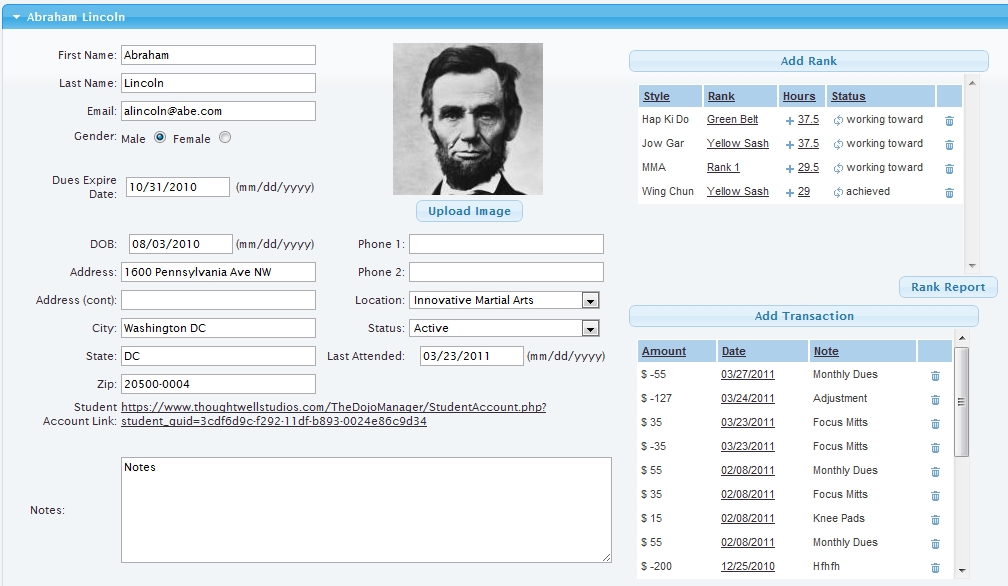
Often times when we get together, we discuss martial arts, fitness, food, family and general life encounters. Most of us do not delve deeply into our day-to-day work lives. For example, did you know that KSMA member Dan Williams is an information technology wizard? A while back, Dan designed the code for this cool tool - The Dojo Manager. I have been using it to track student progress and potential leads for a couple months now and have found it very helpful. Please check in with Dan on the full capabilities of the program. I know I have just skimmed the surface, but this is how it is helping me with the day-to-day bookkeeping for my school. Starting with the Basics What’s a school without students? When students are added, the default setting for them is “active.” There is an “inactive” status you can choose as well if someone goes on a hiatus from your school. If they don’t return after a certain amount of time, you can delete their profile (as long as they are marked inactive). Under each student’s profile, you can input a variety of information. There are fields for the obvious stuff: name, address. You can also add personal information like birthday, class attendance, images and more. A catch-all note section is also provided for whatever you may need outside of the standard sections.  The system includes an option to have multiple locations, and you can indicate where the student trains. You can also input the ranking of your system then apply that system to students’ profiles to track their progress. This is super easy once you assign the system to the student, you can click a plus button next to the hours earned, and it adds your default length of class. Tracking the Benjamins Critical to keeping any school rolling is money. The Dojo Manager makes payment schedules and transactions a breeze. You are able to add transactions which generate a printable invoice for each student. The invoice can also indicate when their dues expire if you work on a dues basis. Marketing Another section which I find very useful is for visitors and leads. I have the option of tracking everyone who has contacted me about the school and do a follow up if they provide that information. This is the perfect place to track how the student heard about your school: web, friend, advertisement, etc. This is an excellent way to track return on investment (ROI) to know you are spending your advertising/marketing dollars wisely. Beyond Regular Classes If you host seminars there is an Events page. This page also doubles as a place to track testing schedules. That wraps up the pages I have had a chance to explore, but you may have a purpose for the other pages which include: Expenses (track that money), Bulk Actions and Reports. The My Account page is for your pertinent information such as standard class duration (this is linked to the plus button to track time on the mat for each student). There is another tab on the Account page that allows you to set up standard transactions. This is handy as well if you have several payment options. All in all, I can recommend this system as an economical way to get a handle on part of the management side of your school’s activities. Oh, and by the way, it is donation based. Help the brother out and kick him some greenbacks if you find the Dojo Manager as cool as I do!
In the BeginningIn the late 90s, Kapatiran Suntukan Martial Arts (KSMA) began in an environment of rancor and mudslinging on early internet forums and gossip at gatherings. The idea that the message (the arts) was getting lost behind egos and politics led Brandt Smith to form KSMA. It would be an open community free of the bickering which was becoming more the norm than training. It would be tribal in the sense that everyone had a role regardless of skill level. Those roles would be apparent at the times we would get together or be borne out of the meetings. Ultimately, the knowledge would be shared amongst the group. We could be sounding boards for ideas and bodies to toss around and experiment with. So the group began and continued on. Over the years, KSMA has strived to maintain that open atmosphere and welcomed those interested in coming under the canopy as long as they met the few criteria established when the group was founded. In return, KSMA would provide the “necessary administrative and mental support toward the associated instructors.” The original intent was to avoid a headmaster-type person and not have a “tiered structure, but a brotherhood.” Since Jay was handed the reins in 2006, he has tried to maintain this style of organization and keep the conversations between us going. This can be difficult because of the various factors which hinder us in the modern age: Distance, timing and availability. Look Where We AreKSMA of the present is a loose group insomuch that we are there for each other if needed. Many of us have personally experienced the willingness to help each other reach an understanding with the skills and knowledge of fellow members. Most of us have a primary focus combined with a love of learning. How far we reach beyond our core art is based on personal preference. We respect this and appreciate it. We are thankful of all the relationships which have developed over the years and look back with fondness, and some regret, toward those who have left who helped us grow. We honor those who shared the information by letting others know from where that knowledge came. One attempt to move the group forward was to establish the Brothers in the Arts inner core for the group. This could be best described as a hub to the wheel that is the group. Perhaps, it was a step toward the tiers that may seem outside the original intent of the group slightly, but it reflected the actuality of the growth of the group and is a realization of what was a original goal: “To have a number of representatives across the nation that reflected the intent of the group.” It was also an attempt to have more input across the board in an effort to avoid the aforementioned headmaster, as one of the reasons for founding the group was to provide sources of research and development in the martial arts. Another reason includes being able to offer options to those seeking knowledge, having a sense of brotherhood in sharing openly what we know and learning from others which may lead to insights in what we do individually. Having this group is a natural expression of KSMA. This group helped to establish focal points for the group. This had a positive effect of broadening the circle of members and giving us places to get together on a regular basis. The Road AheadWithout form, there is no path. As KSMA has been loosely formed in the past and becoming looser each year, it was decided to take our organization one step further. It is out hope that with a little structure, we can take KSMA to the next level. Our vision of how to help our organization survive and thrive looks like this. Mission StatementKapatiran Suntukan Martial Arts is dedicated to further study and the education of interested parties in various systems of martial arts and Personal Survival Tactics and give support as needed to members. Members are obligated to share their knowledge as well as learn. All parties involved with the group shall be upstanding citizens of their communities.The group will be led by Terry Trahan and Jay Carstensen acting as Co-directors. In the event they reach an impasse, Bobbe Edmonds will act as third party intermediary. Terry and Jay will oversee the group and make decisions regarding its activities, membership and direction. General MembershipAs a member of KSMA, you will receive - A support network Recognition of hard work and dedication Opportunity to train with a wide range of people Discounts for sanctioned events Access to a variety of instructors Inclusive environment for exploration and expansion of your art Electronic newsletter featuring news and technique breakdowns Access to the group FTP site Membership requirements are as follows. All potential members will be met face-to-face Attend at least 1 KSMA sanctioned event annually Learn, develop and share your knowledge Train regularly and consistently - You don’t have to train what we train, but you have to train Maintain regular contact with the co-directors Be good - Don’t be a dick. Use of the terms and logos for Kapatiran Suntukan Martial Arts, KSMA, Aneh Palu Kali-Silat, and Personal Survival Tactics need written permission from the co-directors Members will be required to attend at the KSMA annual event. If you can’t make it, then host your own. If you host your own, we will discuss who will teach and what will be taught. We don’t want these things to break the bank as we are still of the mindset to keep things affordable. Eventually, there will be a “pot” for KSMA to draw from. The money will be put toward various aspects for the advancement of the group, such as assisting in offsetting costs for seminars or helping to fund various tangibles like certificates, member passbook logs and swag. The fee structure is below. Study GroupThe Study Group Program has two options. The KSMA Instructor Development Program is for anyone wishing to learn Personal Survival Tactics or Aneh Palu Kali-Silat as taught at seminars by Terry and Jay and teach it to interested parties with KSMA endorsement. This will be accomplished with a combination of distance learning and seminars for those not in the same locale as Terry or Jay. Upon entering the Instructor Development Program, the student will be given the first level of the curriculum they choose to study and will be given permission to form the Study Group. Video progress updates will be sent to either Terry or Jay to be reviewed and comments made for the student. Subsequent levels will be offered when the Study Group Leader meets the skill sets laid out in each level. Leaders of the Study Groups will also meet the requirements of KSMA membership to maintain eligibility. Those who train with the Study Group Leader that have not had a face-to-face meeting with either Terry or Jay are not members of KSMA until after such time as an introduction can take place and they meet the criteria laid out for inclusion in the group. The second Study Group option is for people who are in an art other than what we offer. We see this as a research and development lab to take your art to whatever level you wish. We will provide insight, critique, and encouragement in an environment where you can delve deeper without judgement. You can pick any aspect of your art to explore for in-depth study, provide an idea of what you look to discover and send a video of your study. If desired, we will share this with the whole group for discussion, otherwise we can provide feedback on your premise and findings to help you grow within your art. The Brothers in the Arts group will cease to exist and those wishing to be active in the group can opt for the Study Group affiliation described above. This move will take us back to the non-hierarchal intent of the group. In the future, please refrain from using the name and logo unless you are a member. Details regarding usage will be offered to you upon registration. Any organization has expenses and in order to stay on top of what will be needed for the group, KSMA will have an annually paid membership. This will cover the necessary expenses involved with running the organization. Also, we have found that in order for people to take things seriously, there has to be a buy-in of some sort. We recognize this may limit participants, but we also see that as a plus because those who are “in” are dedicated to their studies and to the ideals and mission of the group. KSMA Fee Structure General Membership-$50 Annually Study Group (Price includes General Membership)-$50 Annually + $10 per student Testing Fees Level Testing $75 per test Instructor FREE Seminars Taught by Terry and/or Jay Lodging and travel is the responsibility of the host-varies and is dependent on mode of transportation and locale of lodging. One Day 8 hours of instruction $275 one instructor $425 two instructors Two Day 16 hours of instruction $425 one instructor $650 two instructors Full Weekend 21 hours of instruction Friday evening is at the host’s prerogative to open it to all or be a private session for invited attendees only
$600 one instructor $850 two instructors Any profit over covering the costs of the seminar and lodging will be split between KSMA and the host. Tip your waitressesIn conclusion, these changes were not come to lightly. This is an evolutionary step for the group and one that must be made to facilitate growth. We look forward to walking together down this new path.
A few years ago, the KSMA community stepped up to help one of our own with a medical issue and it had a positive outcome. Now there is another friend in need. Bobbe Edmonds injured his back a while ago and is trying to raise the funds to be able to continue training us. If you are able in any way to contribute, I urge you to send whatever amount is comfortable to his paypal account he set up to raise the cash to pay for his surgery. He is closer everyday to being back on his feet and working out. Please send your donation to Fistwind@att.net Thanks and take care of yourselves! Jay
Guest Blogger Bobbe Edmonds
Motion is to Pencak Silat what Rooted Stances are to Karate
Stance + Posture = Structure
Structure + Footwork = Mobility
Structure divided by Footwork = Mobility vs. Stability
In the above equations I am using the following terms and definitions in a calculated formulae:
1: Stance: The position and transition of all body elements from the waist down. This sometimes includes the spine.
2: Posture: Position and alignment of all body elements from the waist up. This always includes the spine.
3: Structure: The marriage of Stance and Posture to reflect the needs of the body’s defenses or attack at any given time. Structure is a fluid concept, it does not mean “Stance” or “Footwork”, it means the use of a variety of postures in Silat while maintaining balance in motion.
“Stance” in the accepted Martial Arts reference can be misleading when it comes to Pencak Silat. In the fundamental training of any Martial Art, a stance is noted as a means of sinking the body closer to the ground using the legs for support and stabilization. Now, we do that anyway, every day, just by walking. But a stance is more of an unmoving thing, and the word itself when in reference to Martial Arts usually invokes a kind of statuesque image, the practitioner in a deep-seated squat of some sort, tensing his body and rooting himself as much as possible. Although this is a correct definition, it’s not a really a true one.
Balance is the heart of stance work, and any art worth its salt will show this early on. Pencak Silat is no different in this regard, only in the approach. In any art, there are essentially two applications of balance in Silat, and they both serve an important purpose:
1: Balance in STILLNESS (Rooted stance, sinking/squatting with a wide base, almost no mobility at all) 2: Balance in MOTION (Footwork, Body English, high mobility & ground coverage)
Balance in stillness isn’t difficult to achieve, it only presents one option: Stand still and find your balance. You would have to be a pretty thick brick to not have some degree of mastery over this after a few months of training. Some arts specialize in this, the common rationale behind such training being that you must be able to stand there and absorb ANYTHING that is being hurled at you. Indeed, most arts advocate sinking deeper in whatever stance and rooting to the ground to appear “immoveable”. The fallacy with that sort of thinking is that it’s only one side of a two sided coin: Motion is just as important as static rooting, and a lack of one will force you to overcompensate with the other. Thus will begin a long confusing road of trying to force the fit of something into a situation where it doesn’t belong, a place where common sense should have just pointed to MOVING out of the way for a better vantage point.
Balance in motion is the more difficult concept, it doesn’t have a permanent place of residence and therefore harder to nail down in specific terms and postures.
You can observe the stance-posture-structure relationship in any martial art and discover how it supports the nuances of that particular style: Pencak Silat is mobile and fluid, so less time is spent in rooted positions. Karate is more rigid in terms of posture and stance, so it’s mobility lends itself to the rooted approach. Southern Chinese Kung Fu styles usually have a blend of the two, although it’s never a balanced one, the static sink/root method being the more dominant.
To understand the unique use of stance in Kali and Pencak Silat, first look at the objective of these arts: Motion. Everything in the combat systems of the Archipelagos points to MOVING, not ROOTING. Think of stance like this: If you are constantly moving with an innate sense of balance and coordination, then your stance becomes just wherever you happen to be standing, in whatever position your legs/feet happen to be in. It’s not something you think about, or have to look down to make sure it’s there; if you train for it then it WILL be there. The first action in the feet should be to move, not root to the ground. You need to be able to find balance and stability in motion, moving from one point to another without achieving the rooted aspect of stance. If your first action is to sink and root, then you will have to bring your musculature back to the initial point of relaxation before you can move at all, and who has that kind of time in a fight? Mobility is necessary for entries, evasion and counters. Mobility allows you to adjust for sudden changes in tempo and rhythm of the fight, as well as drastic shifts in terrain, conditions, etc. Mobility promotes adaptability, and helps you maintain a feeling with your opponent at several angles at once. Rooting in stance/structure only applies in a force-against-force contest, something you should be striving to avoid.
The rooting method is usually the first style of stance work trained, and therefore it’s the style that’s emphasized the longest in a practitioner’s life. It’s embedded in his mind, and he will always return to it because it was drilled in as a beginner. Because of this, progression is really the key when training stance. Most beginning students can’t tell their left from their right when they start training Martial Arts, and complex motor patterns will only confuse them. In this respect, focused stance training is fundamental because it teaches a slow step by step process of transitioning from one space to another in a specific manner. Without this training, the beginner will usually have a much rougher road to achieving flow in Silat. That being said, there should be a natural progression OUT of stance work and INTO footwork/Body English, a progression that should move with the momentum of the student’s learning curve. If you delay the transition into motion, then the student gets used to drilling in a static stance, and will have a knee-jerk impulse to “sink and root” in preparation of any conflict.
The problem with this approach is that it encourages you to “sink into a stance” during times of stress in combat, and root when you should move. It is a static element brought into a dynamic atmosphere (fighting). In training different Martial Arts styles, I have discovered that the traditionalist is often taught that the right stance can counter anything, and by implication, if their stance is strong enough then they can withstand even the most brutal attacks. There is some merit to this, and it does have application…But it’s not really a strategy you can go to war with. A rooted stance of ANY sort only works in one direction at a time: The front, or whichever way you are facing/direction you are going, and it will assuredly stack the deck against you in a fight because you will feel encouraged to either stand in the path of danger and “absorb it” as if you were a tree, or meet the attacking force head-on. This is not a very prudent strategy, especially if your opponent is faster or stronger than you, and it will cause you to make poor decisions in combat because you chose a poor position to begin with, and will constantly be playing “catch up” to your opponent’s lead.
Also, if you were successful in the initial clash and you did manage to deflect the incoming barrage, you will likely have every muscle and joint locked down, with the muscle mass so dense and rigid it can hardly move at all. You will be inhibited from responding to any openings quickly, nor will you be able to recover or change positions with any real speed, you must unclench your body first. Once you activate density in your body during combat stress, you will find it difficult (if not impossible) to regain mobility and relaxation needed for fluidity, because you have an innate momentum built up in favor of tension over relaxed, dynamic motion. Again, you will return to your first principles, the thing you were taught at the beginning, only it will be working against you even if you are doing it right.
It may seem as if I am campaigning against the rooted stance approach. Actually, it’s a necessary element, and it does have its uses…but they are far more limited than the use of mobility, and it doesn’t lend itself to fluidity very easily. For this reason you must have a firm grasp of the uses and disadvantages of each.
There is much written about the mathematical and mechanical elements of stance, many calculations, diagrams and equations laid out to give the appearance of something more meaningful than simply “balance in motion”. In a motion-based martial art, this idea is fundamentally wrong, and it’s a mistake to pursue some algebraic formulae hidden within horse stance, except maybe as an academic exercise. Not that the math itself won’t add up, it will. In fact, if you try hard enough you will discover several different formulae for each stance you know. However, the focus will always be on finding that math in the first place, looking for geometrical patterns in every stance instead of looking for the fluidity OUT of stance.
Next on the list: Posture.
By posture, let me say right off the bat that I am not speaking of “proper bone alignment” or “correct shoulder-spinal placement” like what you get from etiquette class. This isn’t the kind of straight-backed walking posture, but how you position your upper body in relationship with two separate points: Your feet & your opponent. Your posture will reflect your ability to move, defend or attack, depending on how you position yourself against an opponent.
Structure is the final element, and it’s last for a reason: You will have to master Stance and Posture to get to Structure, because it’s a combined element of the first two. Structure deals with our body’s trained and natural defenses, and how we find balance while using them in motion. But the definition of structure isn’t “Stagnant”. There are degrees of stability, and you have to decide what you need more of at the appropriate moment: Rooted, unmovable structure or a fluid, less stable one. There are times for sinking down and absorbing everything coming at you, and times to get the hell out of the way.
Moving allows you to negate an attack when “structure” cannot withstand the force. If you do not know or train for this, then you will not be prepared for it when it hits, nor will you be able to recognize when the opponent is doing it to you. If you train for balance in motion, you will not be confused. Your hands and feet will seem to move almost on their own, and your attention will be focused on the attacker, not how good your stance is. Balance is something you FEEL, not SEE.
When it comes to the Filipino and Indo-Malay martial arts, the name of the game is balance in motion. We don’t simply lurch in one direction and pray to God that we have balance when we arrive. The recognition and capitalization of an opening in your opponent’s defenses will only occur if one or more of you is in motion, usually responding to the other’s motion. To pull this off under combat stress conditions, you must be comfortable and confident in your abilities to flow with balance.
If an opponent is simply standing there with his guard up, why attack? You will need to move to a better position, or change your strategy. Also, motion is critical in countering your opponent mentally. Standing still is a mistake, because it allows your opponent to draw a clear bead on you, plot his attack, and gain the advantage of ground and the ability to adjust for his surroundings, as well as any tactical advantages to be had. Movement makes planning difficult for your opponent and allows you to stack the odds in your favor by choosing the setting & pace of the fight.
Rooting also doesn’t address what to do if the attacker decides to use a feint & you are caught by it. The purpose of feinting is to lure your opponent into over-committing to an attack that was never going to the evident target in the first place, a tactic designed specifically for targeting rooted structure. Mobility will save you, but a rooted, non-mobile structure bets the farm on a single roll of the dice. You better be able to fight perfectly every time, because that’s what you are training for. And nobody ever fights perfectly, something always goes wrong.
This article isn't about "A" versus "B", but to bring to light the glaring differences between the rooted and mobility camps. In the end, you have to have a mastery of all four elements. Then you can decide for yourself what tool is most prudent for your situation, mobility vs. stability, strength vs. speed, footwork/Body English vs. stance.
Last weekend was a celebration at Auraria Self Defense. First, it was the 2 year anniversary of me starting to teach there. But more importantly, I had the opportunity to recognize the hard work put in by my students. It is my honor to announce the promotion to Level One in Applied Self Defense Silat the following; Troy Bernal, studied with me for 5 years+, and really brings out the best in those he trains with. Raja Simha, great analytical ability and beginning to understand letting it flow. He is also responsible for me teaching publicly. Johnathon Colvin, even though he wants to be a cop, he is still the most improved. Shawn Sneed, came in with a lot of his own training, and heads the program, but has taken what he was given and made it his. I also was able to induct Troy, Raja, and Johnny into the KSMA, so we have a branch here, in the birthplace of the organization. A few pictures follow.   
Maha Guro Brian Buzz Smith will be amongst a gaggle of instructors at an event in Illinois in April. I will pass along more information as it becomes available. Here is the skinny sent from Buzz: Friends, April 23 & 24, 2011, FMA Brotherhood Gathering in Belleville, Illinois. This will be momentous occasion for the WSEF.Dignitaries to include GM Anthony Davis, GM Tasi Alo, GM Chuck Cadell, GM Ron Saturno, Guro Brian "Buzz" Smith, Master John Malmo, Guro Kim Satterfield, Guro Wes Bennett, Sifu Ralph Paris & possibly Maha Guro Mike Klement. Also, a very special guest will be LD "Stoney" Stone, Sensei of merit, motivational speaker & just an outstanding individual. There will be 2 days of workouts, seminar time, & privates by appointment. The event is open to the public. This will be an event that the Midwest Martial Arts Community has not seen. This is a collaboration of momentous proportion, encompassing several systems of the FMA. There are adequate accomadations very close by the event please feel free to begin to make your hotel reservations now. This event will be a huge building block for future events in coming years. There will be much more details to come. Please feel free to email me here on MyFMA.net for any questions. Regards, Guro Mike Schwarz
Over the years one can see trends in martial arts. They tend to revolve around the new kid on the scene. A lot of that ripples out across what we train. The next big thing drives established schools to adopt these trends or aspects of them in order to stay fresh. These fads take hold for a few years and play out. On occasion they gain a foothold in a wider circle. However, even that wider circle maintains a niche clientele. Heck, even what comes to the mind of the everyday person as martial arts (tae kwon do, karate, gung fu) are a niche. Regardless of style studied, there is a trend coming down the pike to have a better understanding of violence and its effects. For years, the group I hang out with from time to time has discussed the various aspects of not only the physical but the psychological aspects of what Rory Miller calls, “training to create cripples and corpses.” Some schools will see this as an opportunity to cash in on the next big thing without seeing the long-term advantages to their students. The flip side is the students will take it in without seeing the long-term advantages of the knowledge. What I mean here is the vast majority of the students will listen to the message, take it in, but not use it when they need it most. Knowing something two or three times a week for class or rank testing is not putting into practice. Even practicing doesn’t hit the mark directly. My friend Buddha (short, bearded guy, not the plump-bellied dude you see in some Asian establishments) likes to point out, “all plans go to shit on contact.” He’s got it right. You could train every day and feel pretty good about what you do, but all that goes out the window when the shit hits the fan due to a variety of factors. More and more schools need to bring in people to discuss the reality of violence and the understanding that it comes in so many varieties. It is best to be prepared the best way you can be, but the limitations of knowing that what happens may not be what you are training for. Instructors need to be upfront and frank about what their goals for their students are. If you teach primarily for fitness and competition, you owe it to your students to make them understand that goal and draw a massive line in the sand about what they are learning. Too many factors go into violence to say, “this will happen and you do this.” I think if you want to be well prepared, learn how to be aware of your surroundings. Awareness is one of the best skills you have, and you can train this skill easily. Start by being aware of places where bad things are known to happen, and avoid these places. If you are in a situation where bad things can happen, be aware of exits. Look at the people and pick out who may be doing what you are doing. You are looking for those who are scoping the crowd and in doing so, you show you are aware of what is going on around you. That step alone could help you be passed over by those intent to do bad things. Pay more attention to places you are familiar with as well. Your routine may be being watched and made note of by bad people. What are the exits at your workplace? Is the parking lot monitored? Do you unconsciously go from the store to the car? What are some other suggestions you can come up with to make yourself and others more aware?
Buzz has been invited to the Philippines to share his knowledge of the arts! In his words: Some of you may know that TINK and I are going to the Philippines for our overdue honeymoon. What you may not know is I was invited by Guro Michael Tuscano to stay with him and have him be our guide. I have been trying to find out the true history of Kuntaw and it started in his area of the Philippines. I told him I would be open to teach some of his students of what i know. So he decided to have a seminar for his group. I agreed but I also sugegested that he open it up to any other groups in his area. I agreed to do the seminar for free. He could charge a small fee to cover expenses and put the rest of the proceeds into his organization. I think he was a bit amazed that i would do this. I referred Guro Mike to check out the posts about our Gathering stateside.
I had been trying to make contacts in the Philippines to find the old timers in the art. I finally contacted Grand Master Shanfrank Aycocho and he offered to be our guide thru the Northern philippines and drive us down to meet Guro Mike- a 12 hour drive. When told about the seminar idea- he said he too would do it for free and has stepped up to the plate. Meanwhile Guro Mike contacted a local Arnis master to also participate.
Now it gets better. Guro Mike reserved the Aquinas University to hold our event there.
Here is a note he sent to me:
"Good day Master, I started inviting participants of different Martial Arts Club here, and I also invite some of the Barangay Police/Tanod of the nearest Barangay in Legaspi City including some Security Agencies. And I also write the Managers of different Malls here if they are interested to send their security guards for this training. Yesterday some foreign Martial Artist contacted me for reservation. Master, if there are some Instructors who would like to join to us, the registration fee is for the foods only and the accommodation are at their own risk. I hope it will be a great day for all of us. Thanks very much for the support. God bless you."
I hope to keep everyone informed as it goes along its steamroller path. BuzzThe information about it is below FILIPINO MARTIAL ARTS TRAINING SEMINAR August 14-15, 2010 Aug. 14, 2010 : DM Hall, Aquinas University, Rawis, Legaspi City Aug. 15, 2010 : St. Michael Beach Resort, Sto. Domingo, Albay Hosted by: AQ BICOL ARNIS REPELON- Aquinas Chapter (SHOA KUNE DO STYLE) in cooperation with BICOL ARNIS REPELON, INC. (Main Headquarters) and ABSORB, Inc. (Albay Brotherhood of Strong and Responsible Blackbelts, Inc.) GUEST LECTURERS: Master Brian “Buzz” Smith of Traverse City, Michigan, USA, Founder and Chief Executive Director of AMKA/BAKA and member of KSMA He is also part of the American film SCOURGE as the leading cast and fight director; this movie will be shown this year. GM ShanFrank Aycocho of Metro Manila, Philippines Founder and Chief Executive Director of AMAC-KKAASI (Aycocho Martial Arts Center- Kuntaw Kali Arnis Aycocho System Inc.) Maestro Roger B. Bataller of Legaspi City, Albay, Philippines Founder and Chief Executive Director of BICOL ARNIS REPELON, INC. Open to all Martial Arts enthusiasts. For more information, please contact BROD LYNDON R. ANTE (ABSORB) CP 09103139425; BROD ALVIN SALAZAR (AQ BAR) CP 09177578493; and BROD MICHAEL M. TUSCANO (AQ BAR) at AUL Acctg. Office Tel. (052)-482-0542/ email at: aqbicolarnisrepelon@yahoo.com or kuntaw_sacredstrike@yahoo.com.
|
|